




Noticias UPS | Actualidad Universidad Politécnica Salesiana
Cities for people
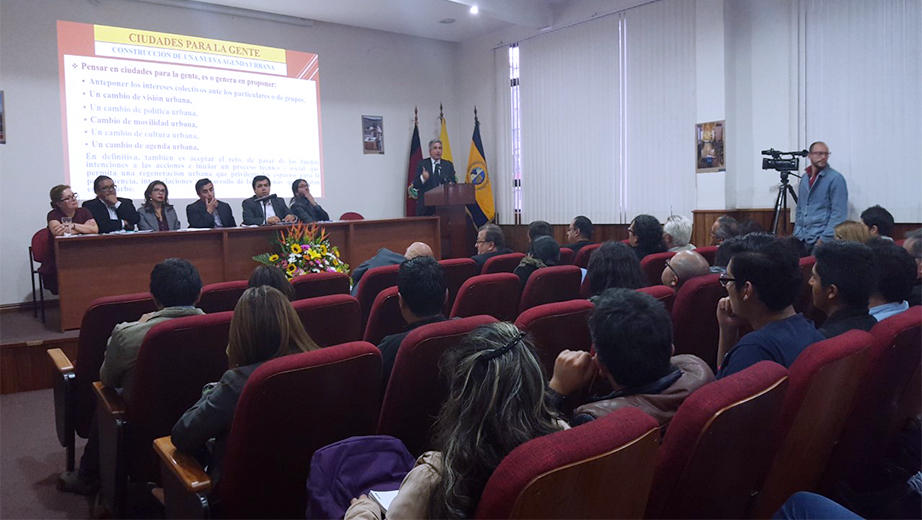
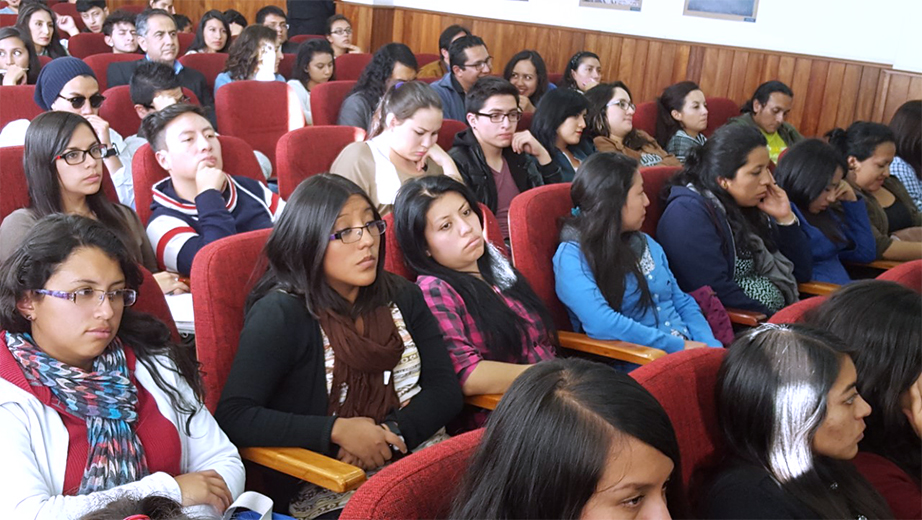
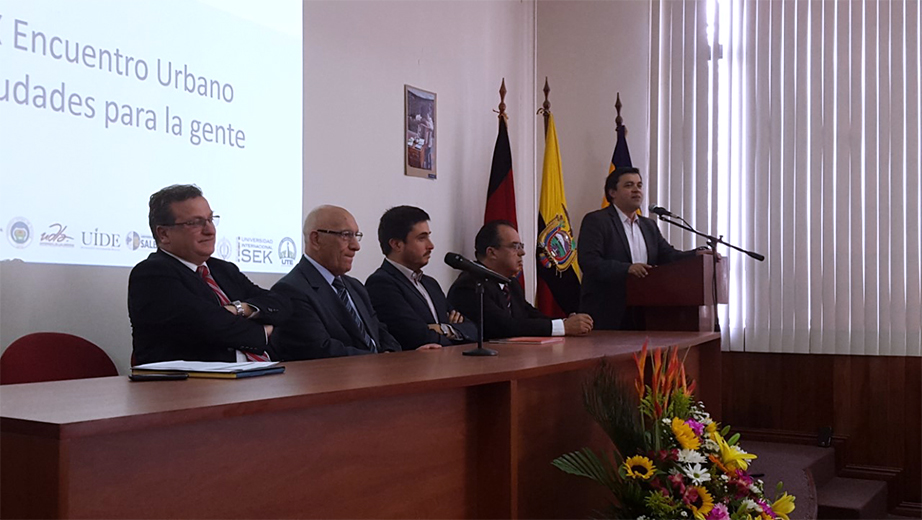
In order to socialize research experiences regarding the city and strengthen academia to prepare for Habitat III, the university's branch in Quito held a conference titled "Cities for people".
The conference, held on September 28th, was organized by UPS and the Academic Network for City Studies. The aim of the network, which is made up by 11 universities in Quito, is to have academic spaces that transcend through a posture of knowledge management of science of the city.
The inauguration was attended by several UPS officials such as: Father Javier Herran, President, Jose Juncoda, vice president of the university's branch in Quito; Juan Pablo Salgado, head of research; Luis Alvarez, general editor; Pablo Ortiz, director of the sustainable development major and a member of the Academic Network for City Studies.
Father Herran gave welcoming remarks and said "the success of the industrial revolution has put the city over the citizen, it is a successful city with losing inhabitants, it does not matter how or at what cost it has been built, but we humans learn from our own mistakes." He also spoke about how the new generations should ask why the city, because they have received an inheritance alien to their needs and desires, "we all belong to that group, students and professors, who are committed to managing our city".
Ortiz spoke on behalf of the Academic Network for City Studies and pointed out that this idea started based on research on problems in cities.
There were three main activities during the event: Firstly, a video documentary: "Youngsters, identity and art in the city", research conducted between 2010 and 2013 by the Sumak Ruray Group, the Childhood, Adolescents and Youth Research Group and the Master's Program in Political Science, Childhood and Adolescence.
After that, there was a discussion panel moderated by Pablo Ortiz, where the topics were:
- Memory and City. The presentation of Quito's Historic Center through photography by Dr. María del Carmen Ramírez, director of the Social Communication major. The ethnographic study is the result of an iconographic historical research on visual representations of the Plaza Grande in Quito's Historic Center.
- Urban indigenous people: The case of the Kitu Kara community in Quito by Professor Freddy Simbaña. The research is based on the experiences and community spokespeople based on four models: land ownership, authority, cultural: plurinational and intercultural and participation.
- Public spaces and ethnic discrimination in the Andean city, by Porfessor Daniela Ochoa. This study was conducted in Riobamba and it is about how current discrimination practices are developed.
- The carbon footprint and its importance in cities, by Professor Richard Vilches. This project seeks to reduce and raise awareness about the effects of gases emitted by the atmosphere through carbon footprint methodology to calculate the amount of C02.
- Rurbanization experiences of indigenous children and youth, CINAJ - CLACSO, by professor and researcher René Unda. The project deals with new processes of socialization of indigenous youth from Tungurahua, Cotopaxi and Chimborazo from the places and spaces of children and youth.
- Construction of a new urban agenda, by Professor Nelson Alvarez, who raised the thought that cities for people means putting collective interest before individual interests
- They also presented the fourth volume of the collection "Cities for People" which is the result of research conducted by those who are part of the Latin American Council of Social Sciences (CLACSO), Universidad Federal de Río de Janeiro and UPS.
Professor Gino Grondona, co-author of the book, made the presentation and mentioned that "volume IV develops and promotes a thought from our realities to urban processes of our societies."
The closing ceremony was led Dr. Luis Alvarez who congratulated the researchers and announced that the collection will be presented soon in Habitat III. Attendees also learned about research projects carried out by professors and students majoring in Environmental Engineering, Anthropology, Local Management and Mechanical Engineering, related to issues of identity, culture, traditions, comprehensive solid waste management and optimization of drinking water. There was also, the photo exhibition "City and memory" organized by the Social Communication major, while the Abya Yala publishing house exhibited books related to topics regarding the city.
Noticias Relacionadas
Noticias Relacionadas


Follow us
Follow us