



A webinar to discuss needs, conditions and the role of teaching during the pandemic
A webinar to discuss needs, conditions and the role of teaching during the pandemic
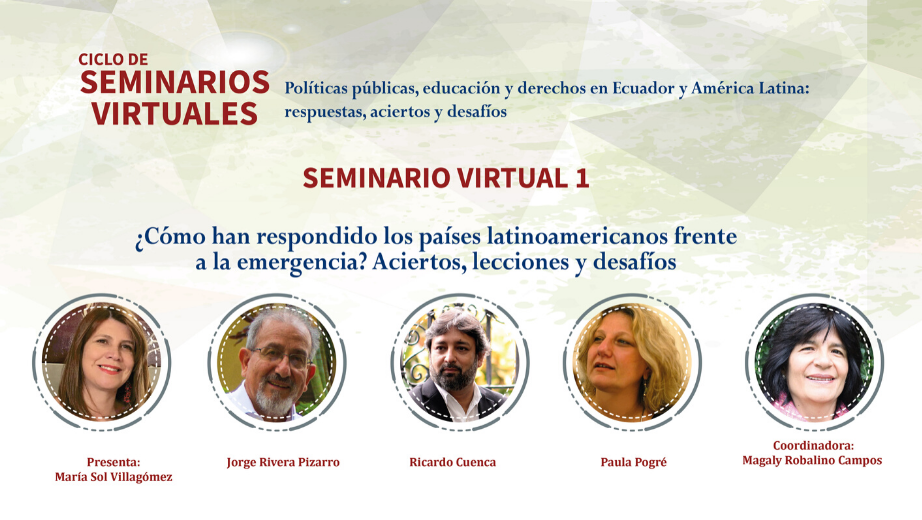
Representatives of Red Estrado – Ecuador, Universidad Politecnica Salesiana and Centro de Investigaciones Sociales y Educativas organized a webinar titled "How have latin american countries responded to the emergency? Successes, lessons and challenges." Researchers spoke about the conditions and roles of teachers during the health emergency caused by COvid 19.
The first talk was led by Paula Pogré, professor and researcher from Universidad General Sarmiento de Argentina; Jorge Rivera, advisor from Coordinación Educativa y Cultural Centroamericana; and Ricardo Cuenca, director of Instituto de Estudios Peruanos. The webinar was attended by students, professors and the overall public from Costa Rica, Peru, Nicaragua and Ecuador.
UPS president Javier Herran, first welcomed everyone to the webinar and then invited participants to be active players in education and not only wait for the State to take action. "Let us be the ones who make changes and innovate because education goes beyond public policies", he said. Maria Sol Villagomez, UPS professor and researcher and the coordinator of Red Estrao – Ecuador, said "these topics are fundamental because they help understand reality and the efforts that encourage educational policies."
Rivera spoke about the experience of management, response and management of the eight ministries of Central America. "We have activated media such as radio and television in order to reach populations that have no access to internet." He also mentioned some limitations, such as the lack of financial resources, technological infrastructure, and preparation of teachers to guarantee the right to education this period.
Pogré believes it is necessary to become aware of the fact that teaching helps understand complexities of society, life and the world. Regarding the curriculum, she said they should be questioned, understanding that schools open windows to the world and gives life. "School is not only the means to understand our community, but a public space that goes much further," he said
Regarding education and citizenship, Cuenca stated that "in today's situation, it is necessary to have clear rules and present authority because this emergency generates uncertainty." He questioned educational systems for only teaching the powers of the state, duties and rights of citizens. "It is an opportunity to rethink new citizenship because citizen behavior is more complex than what schools have been teaching," he said.
The session was moderated by Magaly Robalino, researcher at CENAISE, member of the Red Estrado and the KIPUS Latin America Network. She ended by saying that the right to education must be ensured, beyond limitations; strengthen education on the political agenda and recognize that teaching is essential in all contexts
Noticias relacionadas
Noticias relacionadas


Follow us
Follow us